News
Ringing, tagging and release12/08/2026
An important part of establishing a wild population of white storks in the UK is the annual release of captive-bred juveniles from Cotswold Wildlife Park (CWP). These birds are released at Knepp and other partner sites, boosting the number of young storks in the wild and helping to counter the high mortality experienced by juveniles during migration, which can be as much as 70%. The presence of these additional young birds may also help encourage migratory behaviour within the growing population.
In late July this year, 49 young storks from CWP were processed in a single day. Each bird received a veterinary health check and had a range of biometric measurements taken, including weight and beak, leg and wing length. Tracking devices were also fitted to many of the birds, allowing us to follow their movements after release.
With the help of Aldina Franco from the University of East Anglia (UEA), we were delighted to fit satellite tags to 17 birds from CWP, as well as three young storks from Knepp. For the first time, we also deployed 33 e-rings on CWP birds and seven on Knepp birds.
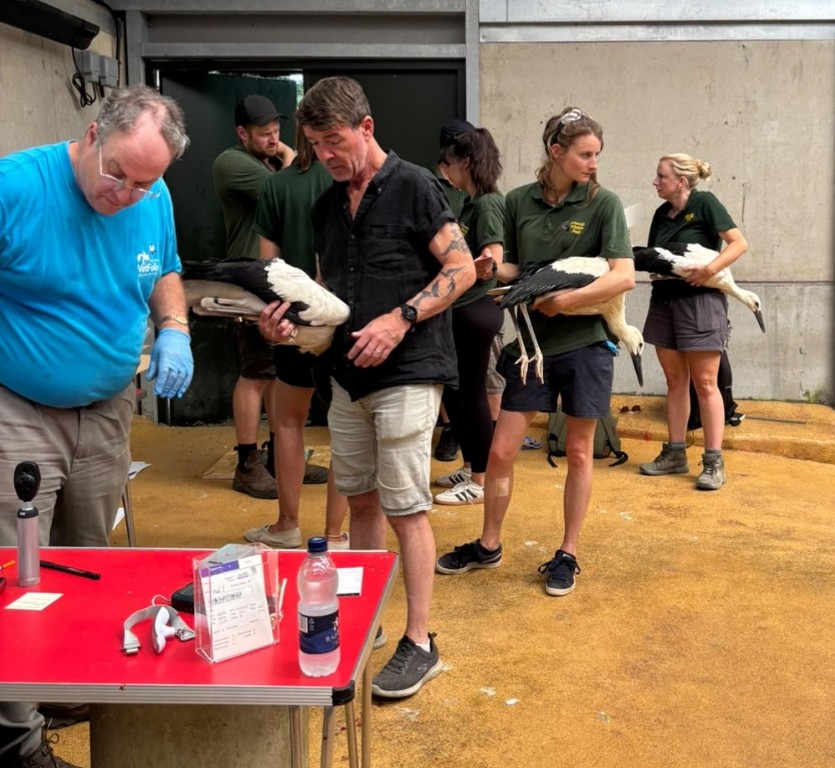
Unlike satellite tags, which are worn like a lightweight backpack, e-rings are fitted to a bird’s leg. They use signals from nearby iPhones to provide location data, working in a similar way to an Apple AirTag.
Together, these tracking technologies will help us gain a better understanding of the storks’ movements, dispersal and migration. We are grateful for the opportunity to collect such a valuable dataset this year, which will be analysed by researchers at UEA. As in previous years, we will also make the tracking data publicly available on our website, giving everyone the opportunity to follow the birds’ journeys.
Following processing, the 49 young storks were transported to Knepp, where they spent two weeks being cared for in a pre-release enclosure before their release in early August.
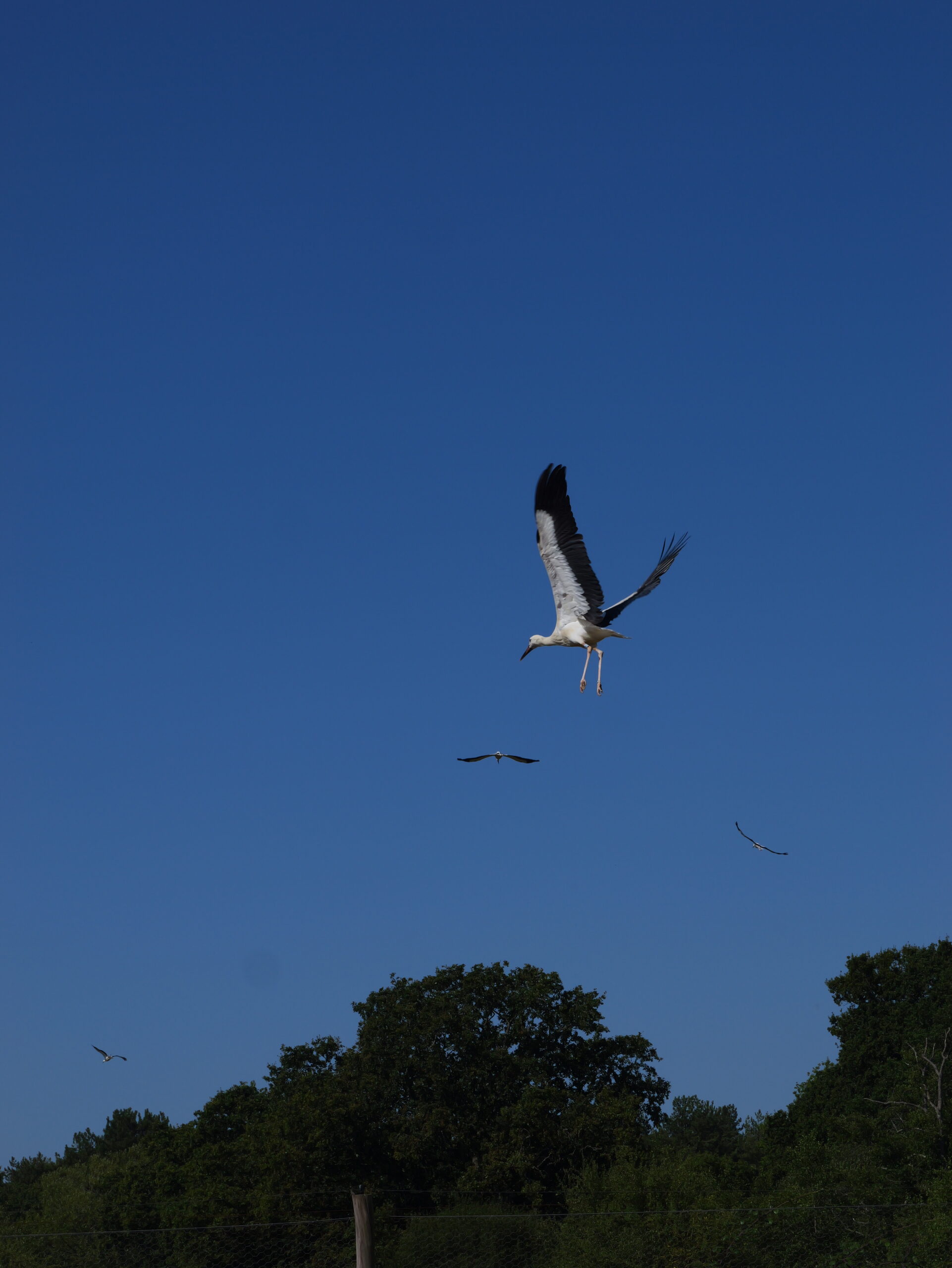
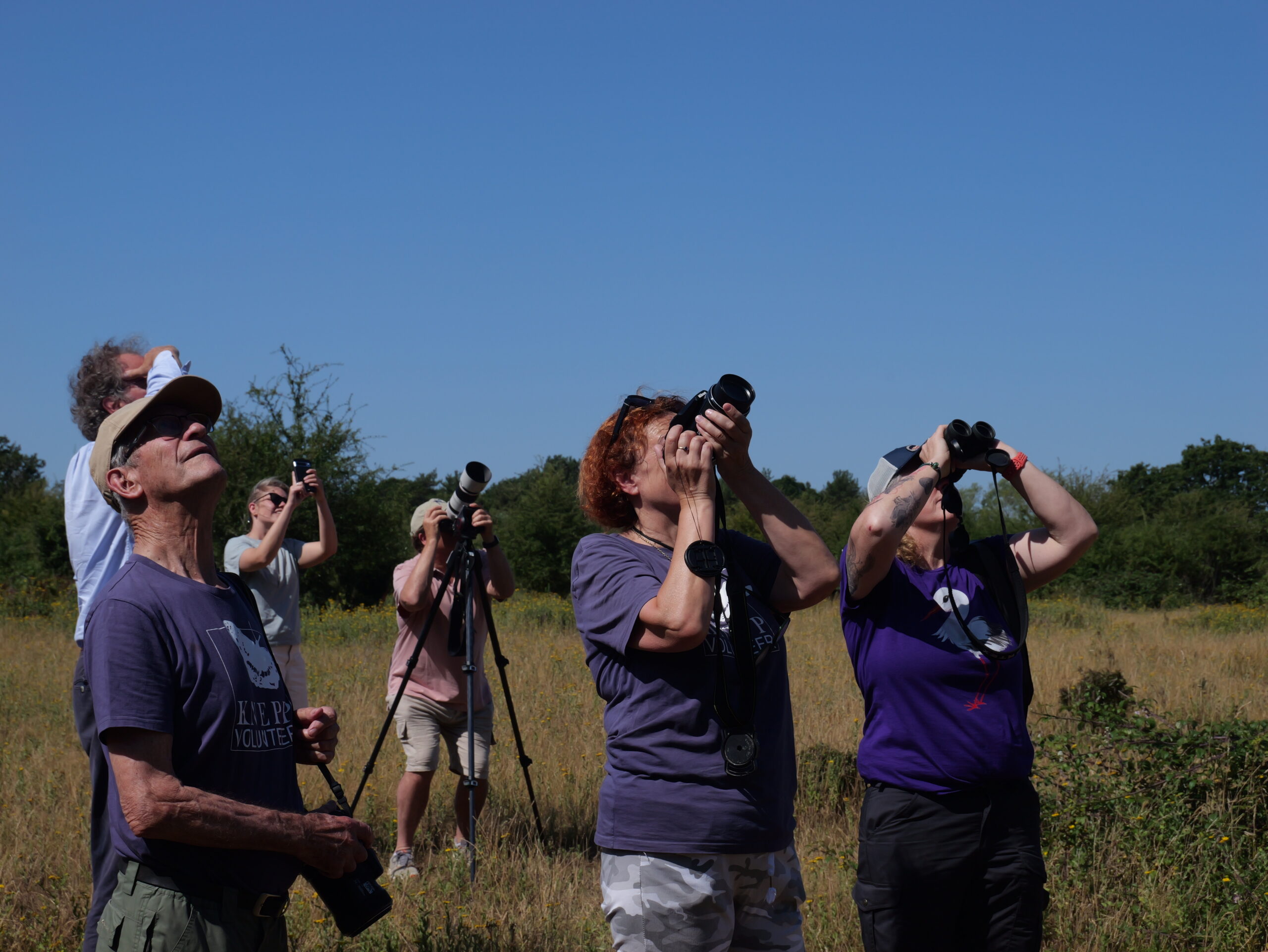
The storks were released early in the morning in fine weather. They immediately took flight and began to integrate with Knepp’s young storks. Over the following hours and days, they were observed learning to forage independently and developing the skills needed to find and use thermals for efficient flight.
Young storks often move up and down the south coast in early August, and one theory is that they are searching for the shortest or most favourable crossing of the English Channel. As large soaring birds, white storks rely heavily on rising columns of warm air, or thermals, to gain height and glide efficiently over long distances. Thermals do not form over water in the same way they do over land, so storks tend to avoid long sea crossings wherever possible.
For these young birds, the weeks ahead will be an important period of exploration and learning. Thanks to the tracking technology fitted this year, we hope to gain even more insight into where they go, how they travel and the routes they take as they begin their journeys south.
We expect to see storks crossing the channel in August and hopefully, as in previous years, making it all the way to north Africa where they may overwinter in agricultural areas, wetland, or even landfill sites.
Thanks to the support of the University of East Anglia and Cotswold Wildlife Park, we will be able to make all of this tracking data publicly accessible on our website, as we have done in previous years. With such a large dataset to process this year, it will take a few weeks for the tracking maps to be fully up and running. In the meantime, we will continue to share interesting stories from individual birds on our social media channels and here on the website.
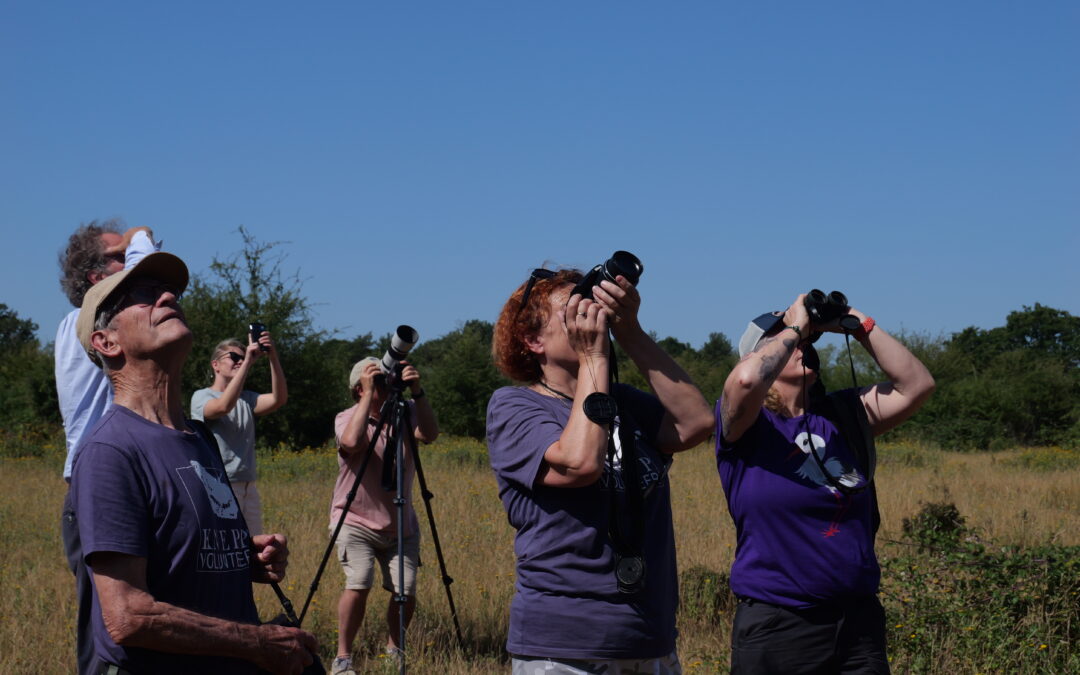
While tracking technology gives us an invaluable insight into where the birds go and how they behave, observations from people on the ground are just as important. Thank you to everyone who has contributed to our understanding of stork movements by reporting a sighting.
Please continue to keep an eye out for white storks, particularly along the south coast of the UK throughout August. If you spot one, we would love to hear from you. You can submit your sighting using the Report a Stork function on this website. These reports provide valuable information that complements our tracking data and helps us build a more complete picture of how the birds move through the landscape.
If you would like to support the continued use of tracking and research technology as part of the project, please consider making a donation through the Donate tab. Your support will help us continue this research and, we hope, expand it even further next year.