News
Volunteer Spotlight: RosemaryHaving always treasured the magnificence of nature, in January 2019 I was excited to join a group of volunteers who had been invited to attend a ‘white stork training session’. It was held at Knepp Rewilding Project in a secluded 6-acre pen with an electric fence. This had been constructed as the home for injured and rehabilitated white storks. They had been acquired from Poland in 2016.
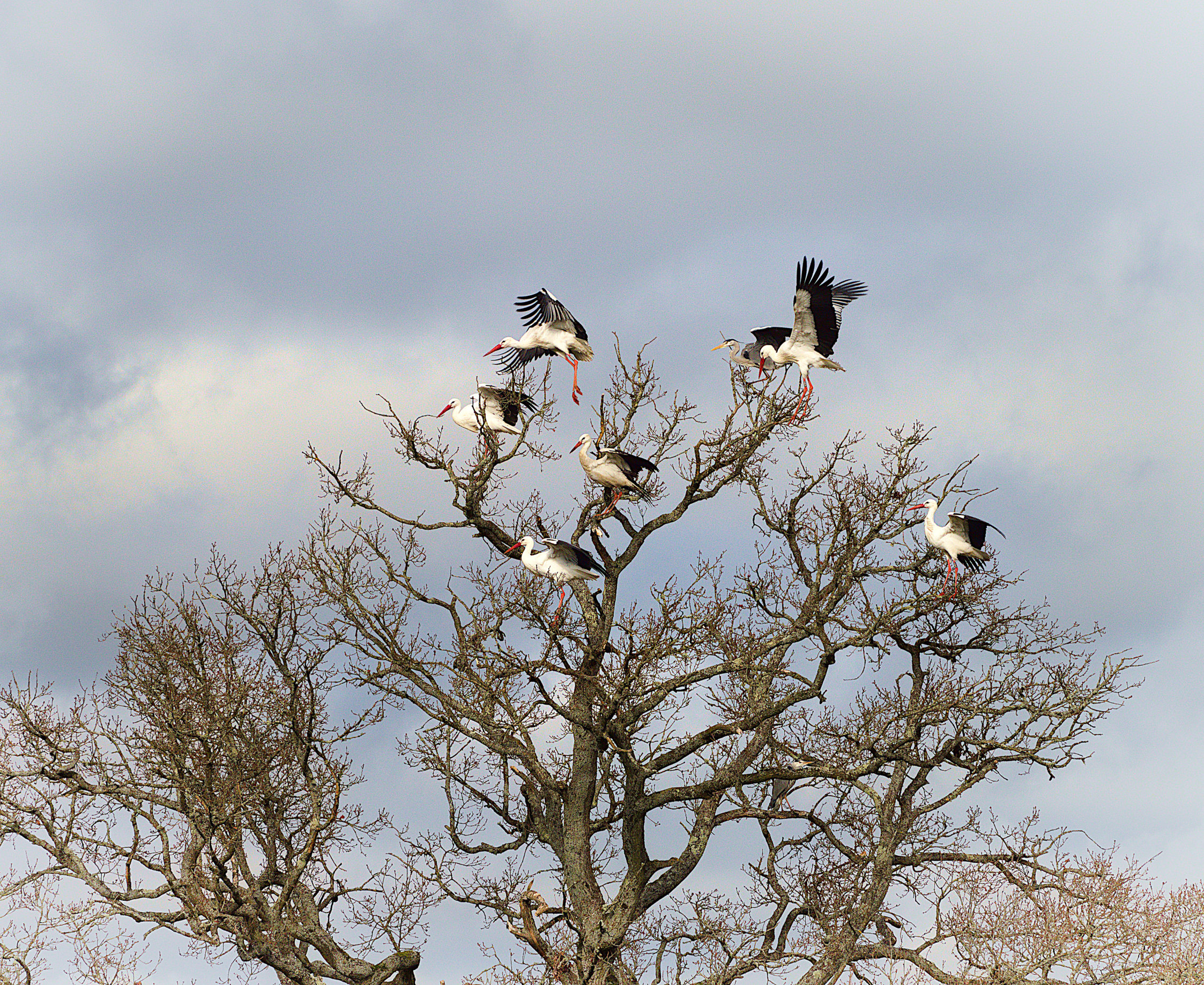
I had never seen these magnificent birds before and was awestruck when we entered the site. The resident birds were joined by some free-flyers attracted by the opportunity of food. A few were gliding above us and over the pond while others soared high above the wooded and grassy areas. Those that were still unable and probably never likely to fly, were making their way down from the scrub, through the trees to the waterside.
Thereafter each of us began putting our name down on the monthly schedule to feed the storks. As I work full time running an education charity, I opt for a weekend date. Initially, the timing of the feed was left to us and so I used to venture out to the enclosure when the forecast weather was most favourable.
It was thrilling to observe progress in 2019 when a pair of storks assembled a magnificent nest not far from the enclosure. They produced three eggs. However, mum was young and they didn’t hatch. The following year there were new enormous nests, two of which had proud parents after four of their chicks successfully fledged.
These were the first white storks born in the wild in the UK for 600 years! Numbers are rising each year as we move ever closer to achieving our target of 50 breeding pairs in the UK by 2030.
Following advice on the team from Cotswold Wildlife Park in 2023, we changed our feeding arrangements and established a routine. With three ground nests in 2023 for the first time, the aim was to encourage more of the nonfliers to feel sufficiently secure to breed. We reduced disturbance by staying away from their wooded area, the pond, the grassy bank and open area above it. Instead, whatever the weather, we began to turn up at about 10.00am to feed the non-flying birds and monitor the storks.
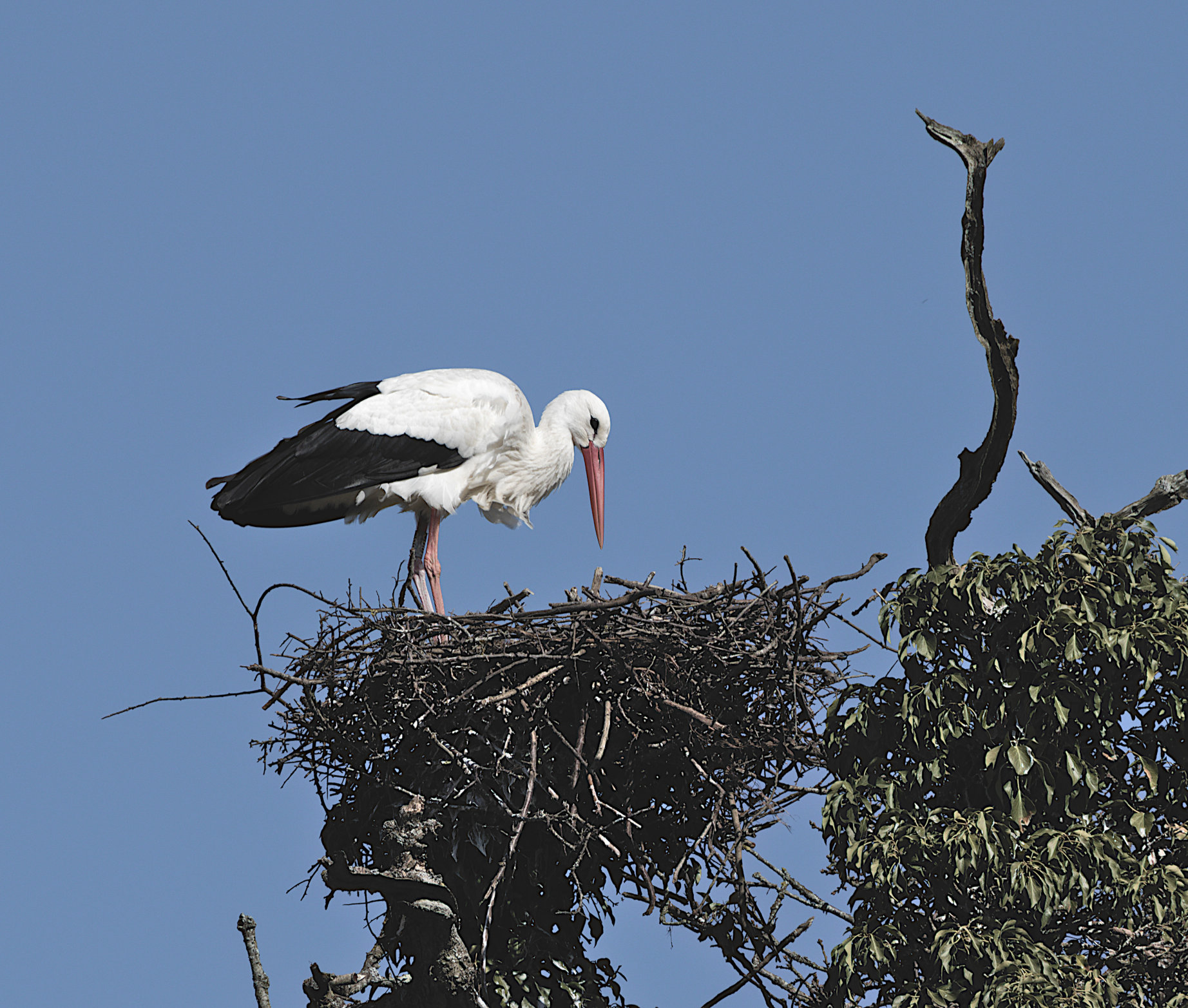
This has paid dividends with growing numbers of non-fliers pairing up and building ground nests – the quality of which varies quite considerably! More of their eggs hatch each year. However, due to their disabilities, their foraging is limited. It is such a treat, once the chicks arrive, to gingerly approach the nests and toss pieces of sprats into them as supplementary food. These offspring go on to fly and migrate as strong, healthy representatives of the colony.
It must be so much more challenging taking off from the ground for a maiden flight than jumping out of a tree nest and mastering the art of flying while gradually losing height!
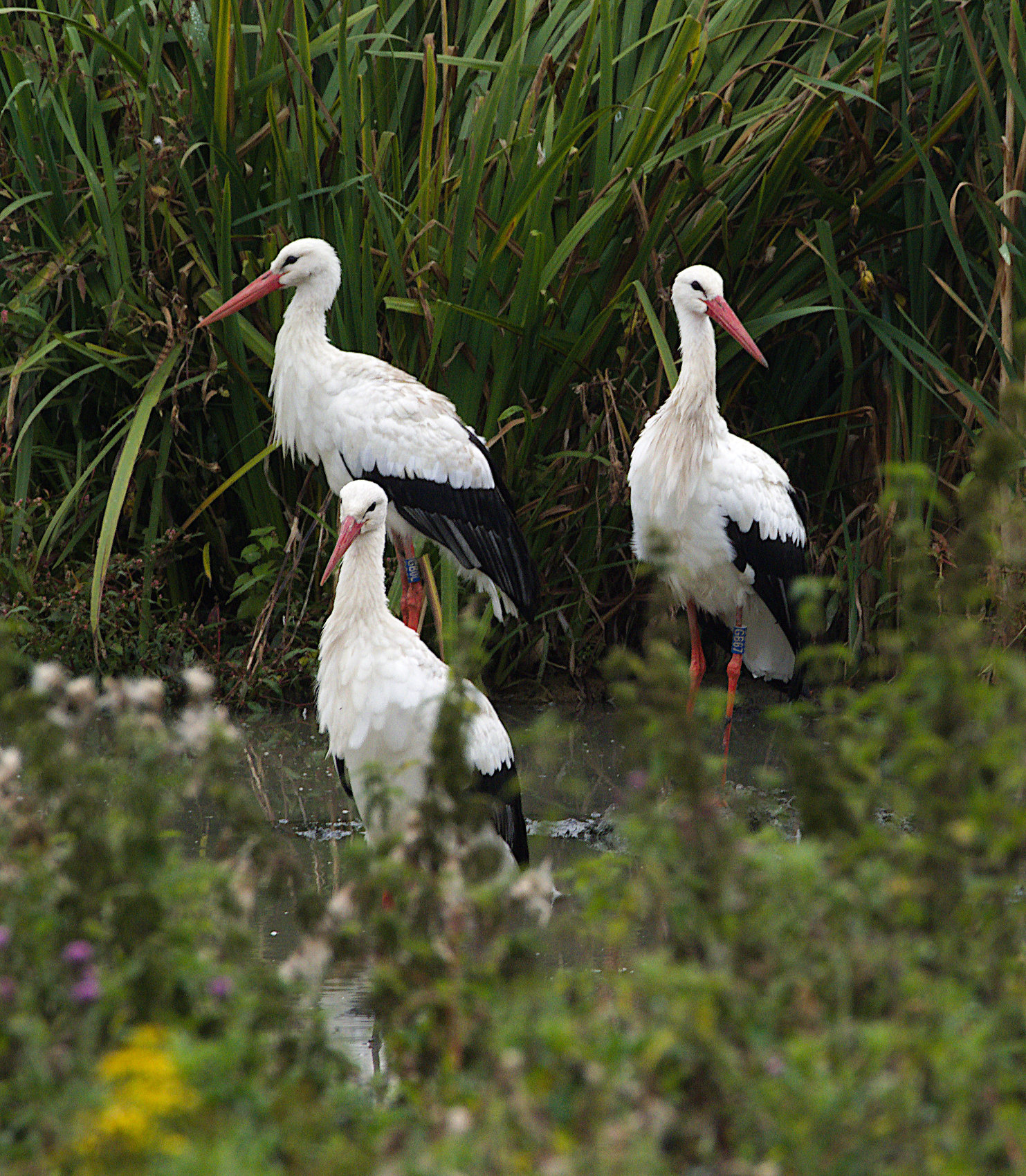
As the project expands, our feistiest stork by far remains GB67. He has successfully raised several families in Nest 4, near the riding stables. From early spring to late July, once we reach the grassy section in the enclosure to deliver food, there can be in excess of 40 fliers waiting for us. GB67 is likely to be at the front of the crowd.
Such is the magic of the changing seasons, sometimes, while within the fenced area and making our way towards the food scattering zones, my feeding buddy, Dawne, and I have put our buckets down and stopped to watch or listen to beautiful sights, creatures and bird activity, including herons, red kites and buzzards, along with the white storks. Dawne has captured some magnificent moments with her camera.
On more than one such occasion, GB67 has started to lead some of his companions along the path towards us and then stopped about ten metres away with an impatient gesture as if to say, “Would you two get a move on with our breakfast!”
Having not missed a month with a feeding date in my diary since January 2019, I was very disappointed to have to forfeit December 2024 because of the pain in one of my hips. Fortunately, I had a replacement operation towards the end of January 2025. With the breeding season fast approaching, I was wondering how long it would be before I could be back, involved in the white storks story
I am moved to write a poem occasionally to express my feelings and so the day after I returned home, while resting in bed, the poem that follows tumbled out of me. It’s from the perspective of our spirited stork, GB67! (Laura, the Project Manager and Penny, Ecologist, are responsible for ringing the juveniles prior to them fledging. In 2024 a camera was placed beside what we refer to as Nest 3a so that we could have an intimate record of the breeding season. We now have a terrific group of volunteers who feed the storks and carefully monitor activity throughout the breeding season. From about mid-August, most of the storks prepare to migrate across the English channel.)
Thanks to brilliant surgery and the challenging exercises the post-operative physiotherapist gave me, I was back feeding the storks again at the end of April 2025.
KNEPP’S MUSTER OF WHITE STORKS
The blue ring on my left leg shows I’m GB67.
We have here in Knepp, a white stork’s patch of heaven.
I stayed here to winter while others ventured to Spain;
I’m keen to get on with nest building again.
Two purple-backed volunteers are approaching our pen:
venison, sprats and chicks are scattered promptly at ten.
That’s Kevin near the lake with a snazzy camera trap;
he doesn’t miss a trick, that smart IT chap!
On our storm-battered old nest, we pile the sticks high,
so our babies will sink in, be cosy and dry.
Other purple-backed monitors are out with their stools;
they’re learning so much, they’re truly not fools!
On the ground, in the wood, nests are forming galore
and up in the oaks, there appear ever more.
Laura and Penny will be dancing with utter delight
but the prospect of IDing will turn them stork white!
The purple backs notice exactly when we lay,
and record each of our movements, day after day.
Veterans over there, with a lens into Nest 3,
are observed doing everything, even a pee!
With a drone overhead, the Storkers tot up our eggs
and time very carefully the rings for new legs.
The purple-backs team checks progress each day
and are eager to see young jump up and away!
The muster has grown; food buckets are full;
we need reinforcing for the migratory pull.
Scouts search the coast; the sea crossing must be short;
some four years abroad could prove to be fraught!
But when mating and families become all the rage,
Knepp beckons us back to shape the next stage.
Poem by Rosemary Dewan
Photographs by Dawne Davis